Why Patients Doubt the Diagnosis (E.326)
“I wish dental problems hurt, because by the time it hurts, it’s something else or it’s too late.”
– Dr. Wade Kifer
Brief Overview of the Episode
A correct diagnosis does not automatically create patient trust.
Dr. Wade Kifer joins Regan Robertson, Sara Hansen, and Victoria Peterson to talk about one of the most delicate moments in dentistry: when a patient hears the diagnosis and thinks, “But nothing hurts.”
Wade brings the perspective of a master clinician who has spent decades sharpening both his dentistry and his communication. A University of Tennessee College of Dentistry graduate, Kois Center student since 2008, AEGD-trained dentist, and President of the Academy of Interdisciplinary Dentofacial Therapy, Wade understands that patients need more than clinical accuracy. They need clarity, confidence, and a team that helps them understand risk without shame or pressure.
This episode gives dentists and teams a better way to talk about cracks, periodontal disease, complex treatment, and prevention so patients can trust what they cannot feel yet.
What This Episode Reveals
- Patients often doubt the diagnosis because they cannot feel the problem yet.
- Trust is built before the doctor enters the room.
- The hygiene handoff can either support the diagnosis or make the doctor start from zero.
- Photos, scans, and technology help, but they do not replace a patient feeling cared for.
What You’ll Learn
- How to respond when a patient says, “It’s not bothering me.”
- Why confident diagnosis needs calm, clear communication.
- How to align your team so patients hear one trusted message.
- Why blaming the disease instead of the patient changes the entire conversation.
If This Sounds Familiar
- Patients want to wait until something hurts.
- Your team sees the concern, but the patient still hesitates.
- Treatment feels obvious clinically, but overwhelming emotionally.
- You know the dentistry is right, but the patient has not connected the risk yet.
Next Steps
If patients are doubting the diagnosis, the answer is not more pressure.
It is better communication.
It is stronger team alignment.
It is a patient experience that helps people feel safe enough to trust what they cannot feel yet.
Listen to the full episode of Why Patients Doubt the Diagnosis and learn how to close the trust gap before pain becomes the patient’s proof.
Patients do not always doubt the dentistry. They doubt what they cannot feel yet.
At Unrestricted, you will step back, look at the quality of your revenue, and build a more intentional path forward for your practice. Because when your diagnosis, communication, and team alignment are clear, patients can make confident decisions before pain becomes the reason they finally say yes.
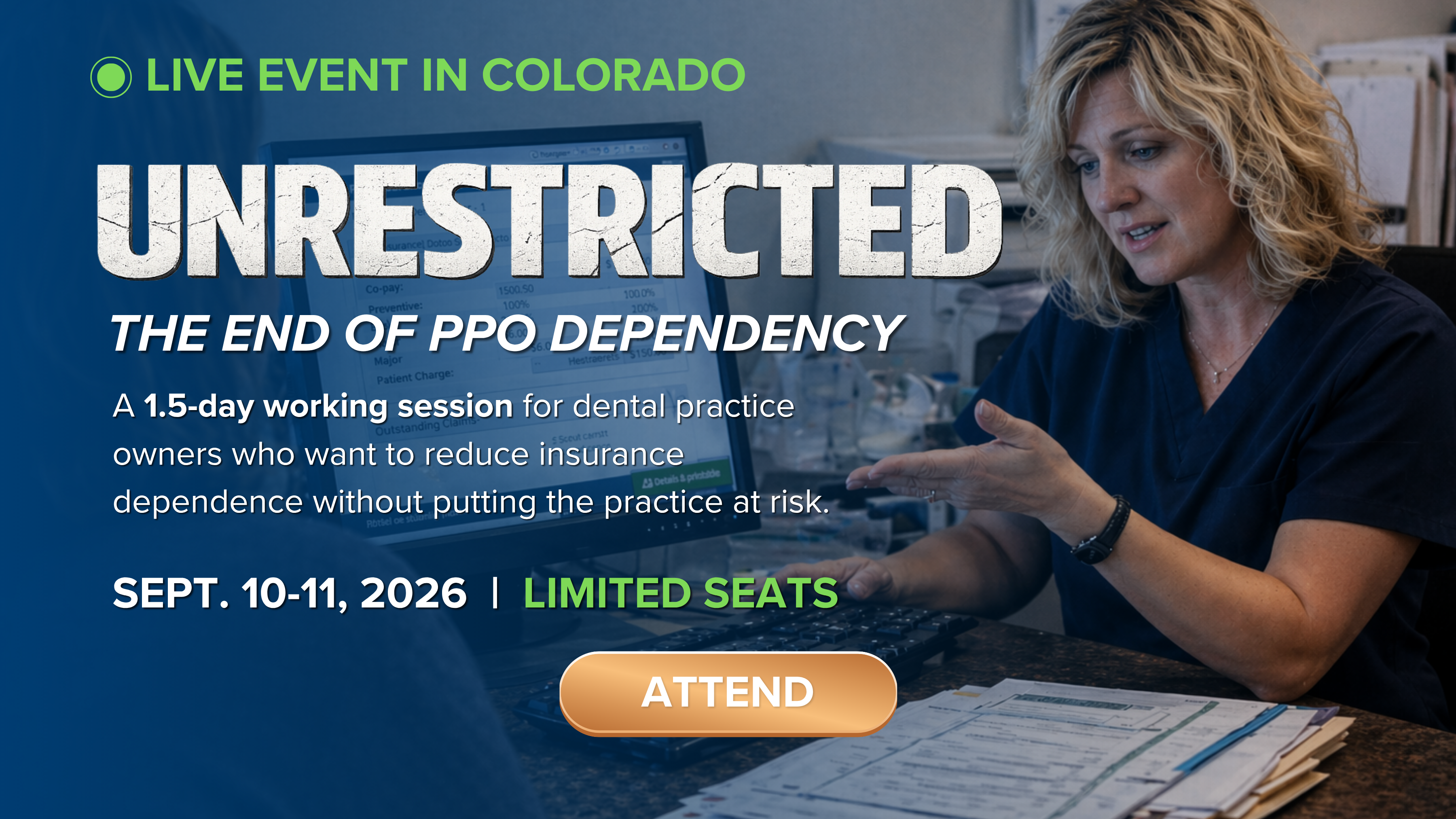
Learn more and reserve your spot: Attend Here
TRANSCRIPT
00:00:00:04 – 00:00:02:14
Speaker 1
The Productive Dentist Academy Podcast network.
00:00:02:15 – 00:00:21:07
Dr. Wade Kifer
When I get that patient and say it’s not bothering me. Say, I get that. And the problem is, I wish this was going to sound bad. And but I always tell the patients I wish dental problems hurt because by the time it hurts, it’s something else or it’s too late.
00:00:21:09 – 00:00:44:21
Regan Robertson
Welcome to a special edition of Everyday Practices Dental Podcast, an investment grade practice podcast. Today we’re starting with one of the most sensitive topics in dentistry why patients doubt the diagnosis. In this two part series, we interviewed doctor Wade Keefer, a practicing dentist at a Fayetteville, Arkansas, as a center course facilitator and productive dentist Academy faculty member with the Clinical Calibration Institute.
00:00:44:22 – 00:01:06:05
Regan Robertson
Doctor Keefer produces 3000 an hour. And yes, he is a clinical master, but he’s an even better communicator and leader. In part one, Doctor Keefer walks us through how trust is built before the doctor ever enters the room. Why your hygiene and doctor handoffs matter so much, and how to talk about risk cracks and complex treatment without shame, pressure or confusion.
00:01:06:09 – 00:01:34:22
Regan Robertson
Let’s jump in. Welcome to another episode of Everyday Practices Dental podcast. Sarah and I are here with two special guests. We have invited Victoria Peterson, CEO and Co-Founder of Productive Dentist Academy and host of the award winning Investment Grade Practice podcast To Be Here with us. In addition to recurring guest and phenomenally productive Dennis doctor Wade Keefer out of Fayetteville, Arkansas.
00:01:34:23 – 00:01:36:13
Regan Robertson
Hi, Wade.
00:01:36:15 – 00:01:39:04
Dr. Wade Kifer
Hey, Reagan. Happy to be here. Looking forward to it.
00:01:39:05 – 00:02:17:22
Regan Robertson
Thank you. This is going to be special listeners because you know, it. It touches on a topic that really goes through marketing and building business value. And it’s really what happens. You know, the reasons why patients doubt the diagnosis. And it’s a sensitive topic and a really, really powerful one. So that’s why we’ve invited Victoria to be part of this as well, not only because of your long history of Victoria in dentistry, but also your history with Wade in particular, and how you have both like seen and experienced each other’s journeys grow over the decades.
00:02:17:24 – 00:02:22:13
Victoria Peterson
I like the way you say that we have history.
00:02:22:15 – 00:02:25:04
Regan Robertson
You go back a bit. Well, you know.
00:02:25:07 – 00:02:37:19
Victoria Peterson
He’s been part of our clinical calibration institute for a long time and just such a great PDA alumni. I don’t think the world would revolve if Wade wasn’t in it, honestly. Sure. Yeah.
00:02:38:00 – 00:02:45:19
Dr. Wade Kifer
It was 2010. I think I started coming to my first PDA conference. So, you know, we’re going on 16 years.
00:02:45:20 – 00:02:51:23
Sara Hansen
Yeah. Happy sweet 16. Wade.
00:02:52:00 – 00:02:52:17
Regan Robertson
Oh.
00:02:52:19 – 00:02:57:11
Victoria Peterson
I can write it there with my anniversary year as well. How about that?
00:02:57:12 – 00:02:58:12
Dr. Wade Kifer
Oh, there you go.
00:02:58:13 – 00:03:03:14
Victoria Peterson
Yeah. Now I’ll remember it. So go ahead, Regan.
00:03:03:16 – 00:03:37:18
Regan Robertson
Well, I was going to say, Victoria, you know, in seeing diagnosis from your own chair side experience and the years that you had, you know, with hygiene and how it’s evolved over time, I’m, I’m curious what you’re most interested in hearing from Wade. Like, like if you think about, you know, our listeners right now who are looking for those little, little nuggets, where do you where do you start off, doctor if pose, have you feeling restricted as a dentist, but you’re not sure if going completely out of network is the right move for you?
00:03:37:19 – 00:03:57:23
Regan Robertson
That tells me that you are right at the stage we’re having a strategy, and plan is essential if you want to protect your revenue and grow. Investment grade practice powered by Productive Dentists Academy is hosting a live event this September that will help you design the right revenue mix for your practice at unrestricted. The end of PPO dependency live hands on workshop.
00:03:57:24 – 00:04:18:19
Regan Robertson
You get to work with renowned business and clinical experts who will help you analyze, clarify, design, align, and activate a plan so you don’t have to feel restricted by pose ever again. Go to investment grade practice today for more information and to secure your seat. This event is strictly limited, so go to investment grade practice today.
00:04:18:20 – 00:04:40:15
Victoria Peterson
Who you know I’m going to I’m going to punt right over to Wade. Because you know as a as a hygienist, what I know is that you take the cues from the doctors in the practice, because we’ve been taught that even if you could drive a truck through a tooth, you can’t legally say there’s a hole in your tooth, right?
00:04:40:16 – 00:05:06:21
Victoria Peterson
And so what I love about you is and all the all the doctors that we work with, you are very conscious of what you can delegate and what you cannot. But you’re also very conscious about empowering your team to educate that patient so that when you come in the room, you’re in agreement. So how important is it? Two part question how important is it that doctors and their hygienists and their treatment coordinators be on the same page?
00:05:06:21 – 00:05:11:00
Victoria Peterson
And then part two is how do you get on the same page?
00:05:11:02 – 00:05:34:08
Dr. Wade Kifer
Well, I mean, how important. It’s almost like a loaded question because if you’re not on the same page, you mean that just decreases the value of the whole appointment to me, right? And as far as, like what they can diagnose and stuff in our practice, as long as they’re coming to it from a place of trying to help the patient out, there’s ways you can.
00:05:34:09 – 00:05:56:20
Dr. Wade Kifer
You don’t have to say that’s caries to say, hey, I’m really worried about that tooth. We may end up needing to do a crown. If we don’t do something on that tooth, you could lose the tooth. I’m going to get Doctor Keefer to check it, but they’ve already created that value for the patient for when I come in, the patient’s almost like, okay, what can we do?
00:05:56:24 – 00:06:25:17
Dr. Wade Kifer
Right? My job is easy. And that’s very valuable. As opposed to they don’t say anything. If I find something that the hygienist didn’t see and I look up, and now I’ve got to start from scratch because the hygienist just said. Because when I look in the mouth, I say, did you notice anything going on? And so while I’m looking, she’s telling me certain areas to look and double check.
00:06:25:17 – 00:06:48:11
Dr. Wade Kifer
And not only does she say, yeah, I want you to check two, three. She’ll say, yeah, found something on three. We’ve talked about it. She gives me feedback right then and there. Of what? The patient’s thinking. Yeah. We found something on three. She knows there’s a crack in it. We’ve talked. It may need a crown. And I’ll say, well, but we want to get your opinion versus.
00:06:48:13 – 00:07:12:09
Dr. Wade Kifer
She found something on I found a little crack on three. The patient said it’s not bothering her at all. That little cue tells me a lot, because now I need to explain why that crack is important. Even though it’s not bothering you versus. Okay. She found something on three. It’s concerning to her. What are we going to do about it?
00:07:12:10 – 00:07:39:06
Dr. Wade Kifer
It’s very slight, but now my level. When the patient says, well, I say, yeah, we can fix that. We’re just going to need to go and put a crown on like Casey said. Yeah. Versus do I have to go into deep explanation or not. And how do we get there? It takes practice. It doesn’t just happen without post appointment meetings where we go, hey, you said this, I thought this.
00:07:39:07 – 00:07:54:12
Dr. Wade Kifer
What were you thinking there? They don’t have to be deep, deep conversations. But just at the end of the day, you talk over 1 or 2 patients with each hygienist, and over time, you just get on the same page. And life’s much easier that way.
00:07:54:14 – 00:08:20:15
Sara Hansen
Oh, wait. Something that you just said sparked what I think so many dentists and dental teams experience every day, which is those patients that, you know, you’ve diagnosed the correct treatment, but they say, well, that one’s not bothering me. And now that doubt starts to creep in from the patient perspective. So tell us a little bit more about how do you, you know, help the patient understand.
00:08:20:16 – 00:08:35:10
Sara Hansen
Because I know risk factors for you is part of just an everyday conversation. But walk us through how you take that doubting patient into treatment acceptance when. But it’s not hurting me. Doctor Keefer.
00:08:35:12 – 00:09:01:20
Dr. Wade Kifer
Yeah, so let’s just do that crack in a tooth. And I’m not just talking to craze line, but maybe you can just explore a tip in there. And so when I get that patient say it’s not bothering me. I say I get that. And the problem is, I wish this is going to sound bad. And but I always tell the patients I wish dental problems hurt because by the time it hurts, it’s something else or it’s too late.
00:09:01:22 – 00:09:20:05
Dr. Wade Kifer
Right. And so I just look at it and say, you know, I wish this would hurt you only so you’d take care of it when we can. And it’s not an extraction and maybe an implant or a root canal. So in a case like yours where I’ve got this, your risk of this tooth breaking. Now, listen, I have plenty of work.
00:09:20:06 – 00:09:42:06
Dr. Wade Kifer
I don’t need to find things. And so if you don’t do anything, that’s fine. I am not going to pressure you. But I wouldn’t be doing my job if I didn’t say this was at a higher risk of future problems. And on me or my wife, I’m putting a crown on that tooth. Ten times out of ten.
00:09:42:08 – 00:09:57:15
Victoria Peterson
You know, what I love about that is that you preemptive the story and the doubt when it does break. If they didn’t follow through with treatment on time and now they don’t come in blaming you. You know, why didn’t you tell me this tooth was going to break?
00:09:57:20 – 00:10:11:19
Dr. Wade Kifer
You know, we get them apologizing to us sometimes when they come in with a broken tooth or the two thing. That’s right. And so it’s like you told me I knew it. I said, that’s okay. We’ll deal with it now. Right.
00:10:11:21 – 00:10:14:20
Sara Hansen
What a coulda should have.
00:10:14:22 – 00:10:35:15
Regan Robertson
Wait. You’re a tremendous communicator. And I don’t think that that can be overstated. It’s just beautiful to hear you walk us through it. And I can always, you know, transfer it over to my own personal experiences with health care and have been in the place of you told me, and I’m sorry, but that grace that you extend to them.
00:10:35:17 – 00:10:59:04
Regan Robertson
You know, a lot of dentists say that they it’s a non-judgmental environment. And I think you just demonstrated a true way that you really are not judging, and you’re there to truly help someone. I’m I’m curious. What do you think patients are really asking themselves when they hear a diagnosis? You know, whether it’s hurting or not hurting, what do you what’s what goes through their head?
00:10:59:06 – 00:11:06:02
Regan Robertson
Or maybe you as your own patient yourself. What goes through your head when you hear a diagnosis that may be surprising?
00:11:06:04 – 00:11:29:16
Dr. Wade Kifer
Well, I always assume when I’m talking to the patient that they’re going to be skeptical, and I want to give them permission to be skeptical. So it’s like Bruce and Victoria always say handle the objection before the objection, right? So when I’m doing that, I say, you know, and all these things, I say we take pictures when we work so that you can see that crack.
00:11:29:17 – 00:11:52:00
Dr. Wade Kifer
Because if I don’t get that crack in time, you know, you could end up needing a root canal or needing losing the tooth. So we take pictures of all the work, and I know we do it to send the insurance, but I will take pictures just so you can see what we do, because I want you to have that assurance that everything is done the best that you can.
00:11:52:00 – 00:12:19:00
Dr. Wade Kifer
And I’ll stand behind our work. We’ll do everything we can to keep you out of trouble. So I expect them to be skeptical. And I kind of handle that objection before the objection. And at the same time, I’m very confident in my treatment plan to, you know, when I was a new baby dentist before I came to PDA, I mean, I would go on to number two, we’re going to do this measles surface in this distal.
00:12:19:00 – 00:12:30:01
Dr. Wade Kifer
And I talk all surfaces. And how many teeth. I don’t even tell them how many cavities they have. When I leave the room I’m like, you’ve got a handful of teeth we need to fix up. I showed you that.
00:12:30:02 – 00:12:33:05
Regan Robertson
That’s now today. Or that was when you were a baby dentist.
00:12:33:07 – 00:12:35:14
Dr. Wade Kifer
Well, today I just say a handful.
00:12:35:15 – 00:12:36:15
Regan Robertson
Oh. You do? Okay.
00:12:36:16 – 00:12:37:00
Dr. Wade Kifer
So.
00:12:37:00 – 00:12:38:00
Sara Hansen
Yeah.
00:12:38:02 – 00:12:38:19
Dr. Wade Kifer
You got to.
00:12:38:21 – 00:12:39:10
Regan Robertson
Say, buddy.
00:12:39:12 – 00:13:02:15
Dr. Wade Kifer
It’s this many. And I’m like, there’s a lot of damage, you know? And I mean, we’re going to get it fixed. But the real key to this is just making sure we don’t continue on with this damage. So, you know, with the tools we have now a days, you’re going to have two treatment plans. I’m going to give you one treatment plan to fix the damage, and another treatment plan to make sure we don’t do this again.
00:13:02:17 – 00:13:17:21
Dr. Wade Kifer
And Casey is going to go over both of those with you. If we can’t, whatever reason, if you can’t afford or don’t have the time or scared to at least fix the damage, we at least need to implement the plan to make sure things aren’t getting worse.
00:13:17:23 – 00:13:33:16
Regan Robertson
Has technology helped you wade in this? Because I know that you’ve said that that dentistry is a natural connection between science and people. How has that changed over your career and what how are you bridging that today when it comes to diagnosis?
00:13:33:18 – 00:14:01:07
Dr. Wade Kifer
Well, I actually look forward a little bit to AI in the different technologies as it comes forward, because, you know, when we can run a spit test until that you have disease from enzymes and things, I think that’ll take a lot of it because now as dentist, I think we have it harder than a lot of medical professionals because probing depths are kind of subjective inflammations kind of subjective.
00:14:01:08 – 00:14:19:21
Dr. Wade Kifer
I mean, we see it, but it’s, you know, you go to the doctor and you get a blood pressure cuff, right? Your red blood count, your white blood count and your blood sugar. They are what they are. You know, the doctors just reading labs. Whereas we have to interpret what we see in the mouth. So I do think that makes it harder.
00:14:19:23 – 00:14:50:00
Dr. Wade Kifer
Bruce would always say he didn’t need photos, but it gives. He had a link with the patient and build trust. Now I still use photos and intro cameras and big DSLR camera photos and still scans. I use all those things and their tools and patients all the time, bragging all these tools that we have. But at the same time, it really comes down to the trust side of it to me is more valuable.
00:14:50:02 – 00:15:11:06
Dr. Wade Kifer
Now. I think a lot of the you know, when we said Baby Dennis, I was just kind of joking. But younger Dennis built those communication skills because, I mean, you’re giving me credit for communication, but it’s a skill to and, you know, I’m trying to get better at it every day. And so just because we do something well doesn’t mean we can’t do it better.
00:15:11:08 – 00:15:33:07
Dr. Wade Kifer
That’s probably my biggest fault. And my team gets annoyed because we can always do it better. So is those technologies come along. I think they help us. But even if, you know, I know Reagan, some of your stories, you go to the doctor. They have all the technology in the world, but if they don’t make you feel like they care, that’s you can’t replace technology with that.
00:15:33:12 – 00:15:45:22
Regan Robertson
Absolutely 100%. I heard the word value pop up and and before we were recording I said, everything is marketing and everything is value in Victoria. No.
00:15:45:24 – 00:15:49:05
Sara Hansen
Not everything is value.
00:15:49:07 – 00:15:51:03
Regan Robertson
Yeah.
00:15:51:05 – 00:15:52:19
Victoria Peterson
Oh, do you want to jump in on that.
00:15:52:20 – 00:15:54:16
Regan Robertson
Yeah, I do want you to jump on that.
00:15:54:17 – 00:16:18:15
Victoria Peterson
Well I heard value, I also weighed I heard you say words like trust and confidence. And you know, this whole topic is about why do patients doubt the diagnosis. And it really does come down to the clinicians confidence you’ve already walked us through. How do I calibrate with my team when when we see this this is what we do or these are the options.
00:16:18:15 – 00:16:43:20
Victoria Peterson
And you had a phrase I attribute this to you. You may have swiped it from the quiz center. And thank you for being on faculty there and giving back to this industry. It’s just so important that next generations and now you get to say next generation doctors keep coming up to to shine the pathway forward. But.
00:16:43:22 – 00:16:56:06
Victoria Peterson
Was it you that said, once you have the diagnosis, the treatment plan writes itself? The most important piece is the diet. Is that or is that Albert Einstein.
00:16:56:10 – 00:17:22:01
Dr. Wade Kifer
Is similar. But and I get from doctor says there’s only one correct diagnosis. Right. So there’s a lot of different treatments we can do to treat that diagnosis. Right. And so I mean if you relate it to some kind of cancer, it’s like, oh, you have this cancer and you do the oral path report. And it’s like, well we could choose immunotherapy, we can choose chemotherapy, we can choose radiation.
00:17:22:01 – 00:17:47:01
Dr. Wade Kifer
And different doctors may have a surgery. All those are treatments for that one diagnosis. But the diagnosis is only one thing. Right. Right. And so I’m confident in my diagnosis and what I’m not I’m not sometimes we just don’t know the diagnosis. And we want to be confident and I don’t know. But then once we have that diagnosis we can discuss I set a crown for that crack tooth.
00:17:47:01 – 00:18:12:20
Dr. Wade Kifer
Could it be an on lace? Could someone argue an inlay? Could it be no treatment at all is a treatment option for that patient. And so when I give a treatment I say I used to give five all five options. And now I say, well this is what I would do in my mouth, right? Because that’s my treatment option and I don’t try to phrase it.
00:18:12:23 – 00:18:25:05
Dr. Wade Kifer
That’s the only way I’ll say there are other things we can do, but this is the one I would do, and we don’t try to confuse them with a bunch of different or treatment plans for that one diagnosis.
00:18:25:07 – 00:18:48:13
Victoria Peterson
I love that so much. And that’s that’s a point that you and I and Jackson, Bean and Michelle and others are that doctor who have laid down some of our clinical. For those who don’t know, the Clinical Calibration Institute is all about diagnosis. That’s it. We’re not in their teaching you how to prep a tooth or how to do any of that.
00:18:48:14 – 00:19:12:23
Victoria Peterson
It’s like, what are your diagnostic tools? Is everybody reading that diagnostic tool the same way? What is stage one two, three and what are the nuances? You know, what is caries? How do you diagnose it. Because once you get the diagnosis right, you could go, you know, sling back beers for the next five weeks and still not have consensus on a treatment plan amongst 12 doctors.
00:19:12:23 – 00:19:39:05
Victoria Peterson
So I love that you give latitude for that because that’s autonomy. And in that you’re giving patient what the American Dental Association, in their code of ethics says is veracity. You are telling them the truth, the whole truth, and then you’re giving them choice. And and that’s our job is to diagnose and give patients enough into education to make an informed choice about their health.
00:19:39:07 – 00:20:04:05
Dr. Wade Kifer
Let me tell you. Yeah. Let me tell you a quick story, because I was just up at a working with some students. And, you know, we look at the measurements and the inflammation, we have bleeding points and we can look at the chart and it is class two, stage B period. You know, but a lot of the dentists there were like, well I would just profi that in my office.
00:20:04:08 – 00:20:06:19
Victoria Peterson
I was going to ask you that.
00:20:06:21 – 00:20:33:07
Dr. Wade Kifer
You know, to them, well, it’s only bleeding in 6 or 7 spots, you know. And so we have so much information now. And that’s what’s great about Michelle Nicollet Calibration Institute. I mean, you can get it in other places, but it’s all packaged there is what how do you diagnose these things? Because when we’re missing that diagnosis, then we’re not giving the patient the best options because that affects their total health.
00:20:33:08 – 00:20:57:18
Dr. Wade Kifer
Right. It’s related to dementia and heart disease and diabetes and all these things. And we know this without a doubt. So if you’re not trained on the diagnosis now, once you get that diagnosis we can discuss arrestin versus scaling and root planning versus lasers versus prayer timing whatever. But if you don’t get the diagnosis right in the first place, then right.
00:20:57:20 – 00:20:59:10
Dr. Wade Kifer
Yeah, you’ll.
00:20:59:12 – 00:21:24:01
Victoria Peterson
Have that gap. I’m just going to let me for a second. Why do we have this gap between pro and periodontal therapy? I mean, every doctor I have ever on boarded, the first question I asked clinically is what’s your what’s your philosophy of care when it comes to periodontal therapy? And the answer is always it depends. And I’m like on what.
00:21:24:02 – 00:21:37:22
Victoria Peterson
Well which is working that day. And you know we had a good one. But then she left and then this one you know likes just doing. And I don’t want to lose them. And like, why is there such a cat that seems to be the battleground. Why why have theories?
00:21:38:02 – 00:22:01:04
Dr. Wade Kifer
I don’t know, because I get the occlusion when it’s harder to diagnose. Unless you have the background of training, but carries and should be the same diagnosis on everyone. I mean, it is laid out if you have this much bone loss and this much inflammation, you tie in these factors. I mean, American Paradigm Association has it all light out.
00:22:01:04 – 00:22:03:01
Dr. Wade Kifer
And it’s it is what.
00:22:03:01 – 00:22:04:15
Victoria Peterson
It is sheet.
00:22:04:20 – 00:22:14:01
Dr. Wade Kifer
Why do we have it on old emanated sheet. And we go over it with the whole team. Right. Because every hygienist should diagnose at the same time and tell me and.
00:22:14:01 – 00:22:23:21
Victoria Peterson
And do you think that we’re getting to the point where salivary testing is critical or that still adjunct?
00:22:23:23 – 00:22:48:05
Dr. Wade Kifer
You know, I use it salivary testing, but I will not say it’s an always. And I’ll give you an example. I had someone in today, 30 years since they’ve been to the dentist. There is tartar everywhere, four and five millimeter pockets. There’s a little bit of bone loss, but I’m like, you know, once I knock off the tartar, this patient’s going to be cold.
00:22:48:05 – 00:22:55:02
Dr. Wade Kifer
And I mean, we got 35,000,035 years of buildup and they’ve still got two millimeters of.
00:22:55:03 – 00:22:56:11
Victoria Peterson
They’re not high risk.
00:22:56:12 – 00:23:20:05
Dr. Wade Kifer
They’re not high risk. Now they need scaling and group planning. They are a periodontal patient. But once we clean them up now I’m actually using the paradigm testing on all the patients we define or find period on that have been coming to their cleanings because now we don’t have the cause. I don’t have 35 years of neglect. I get someone who’s doing everything and they’re still blinking down.
00:23:20:10 – 00:23:21:02
Sara Hansen
Yes.
00:23:21:04 – 00:23:45:04
Dr. Wade Kifer
Right. So if I’ve got you doing everything you’ve you’re doing everything I’ve told you to do and you’re still breaking down, and I’ve got to do the pathogen testing and viral testing. And what is it? What’s the cause? Because I want to treat the cost. Because you’re doing everything right already and we’re having problems. That’s not normal. But I’m not going to brush those problems under the rug because you’ve been coming in every six months either, right?
00:23:45:05 – 00:23:46:21
Dr. Wade Kifer
Because that’s not the diagnosis.
00:23:47:01 – 00:23:55:18
Victoria Peterson
Do you think that explaining these diagnostic tools and these risk factors give patients confidence and remove some of that doubt? Personally.
00:23:55:18 – 00:24:07:06
Dr. Wade Kifer
For me, I think it fits into my communication style of why why we have the problems we have is I’m really big on putting the disease, the blame on the disease, not on the person. Right.
00:24:07:07 – 00:24:09:07
Victoria Peterson
What’s that sound like?
00:24:09:09 – 00:24:37:05
Dr. Wade Kifer
Well, in my practice, for example, I’ll use analogy. I’ll say, do you know, carries cavities is the most common transmissible disease in the world. We also know that periodontal disease is a transmissible disease too. They’re both bacterial infections. Sometimes they have some viral or fungal components. And if it was all about you, meaning if you did a good job taking care of your teeth, you’d have nothing.
00:24:37:06 – 00:24:58:01
Dr. Wade Kifer
If you did a bad job taking care of your teeth, you’d have periodontal disease and cavities. And you can’t imagine how many of my patients have one and not the other. So what I tell you is it’s not about you. So just like eating right and exercising gives you a better chance of health, it does not guarantee health.
00:24:58:02 – 00:25:20:24
Dr. Wade Kifer
I mean, I had a heart attack when I was 37 and I went 160 pounds, right. And so when we do all that, you have to take in your body’s response. And for you, when I’m talking to a patient, you’re doing a great job. I had this conversation today 35 years. You don’t have a single cavity in your mouth, but you’ve got come to cease.
00:25:21:02 – 00:25:37:17
Dr. Wade Kifer
And is that fair? Depends on how you look at it, you know, I mean, everyone’s different. So we’re going to take what you have and come up with a plan for you because. So when a patient asked me, how often do I need to come back? I say often enough to keep the disease away.
00:25:37:19 – 00:25:58:06
Sara Hansen
Oh wait, I love what you’re saying because my dad, for example, you know, he would say to me, Sarah, I hate going the dentist because no matter what I do, I feel like it’s so negative. And they’re telling me, like, I feel like they’re telling me that I don’t brush my teeth and I don’t take care of my teeth because he did have he still has his wisdom teeth.
00:25:58:06 – 00:26:19:14
Sara Hansen
So those pockets are, you know, harder for him to take care of. And what I love, what you said is you’re taking that emotion and kind of that judgment space that we talked about earlier, and you’re removing that and just saying, hey, this is I love what you said. This isn’t about you. Like, because we all take everything personally.
00:26:19:15 – 00:26:56:11
Sara Hansen
Right. But explaining that to the patient, I mean, talk about building trust but also talk about now they’re like, oh, there’s a solution for me. And this isn’t like every time I come in for my six month exam, I’m getting the shame, you know, from Doctor Keefer. So I love that you talk about that. The other piece that I want to bring up is for those listeners who are just listening, Wade is in his console room and has these huge, beautiful, before and after mouth reconstructive cases flashing behind him.
00:26:56:14 – 00:27:00:02
Regan Robertson
Yes, go to YouTube listeners, a YouTube. You’ll be able to see.
00:27:00:02 – 00:27:01:05
Sara Hansen
It.
00:27:01:07 – 00:27:09:24
Regan Robertson
Made up the most beautiful smiles on the freaking planet. Better than celebrity doctors that I’ve seen. So yeah, look up Wade Kuiper. Yeah.
00:27:10:05 – 00:27:16:07
Victoria Peterson
He’s such a celebrity doctor that people don’t know he’s a celebrity doctor. How about that?
00:27:16:09 – 00:27:17:07
Dr. Wade Kifer
Social media?
00:27:17:08 – 00:27:18:12
Regan Robertson
That’s true.
00:27:18:14 – 00:27:20:10
Sara Hansen
We gotta fix that, Wade.
00:27:20:11 – 00:27:23:03
Victoria Peterson
We got all the red carpets headed to Fayetteville.
00:27:23:04 – 00:27:23:10
Sara Hansen
Yeah.
00:27:23:11 – 00:27:26:05
Regan Robertson
I’m pulling us off topic. I’m pulling us off topic.
00:27:26:06 – 00:27:56:22
Sara Hansen
Well, to bring us back where I was going was. So this leads into kind of that other periodontal plus just those big overwhelming, you know, treatment plans that that you talk about with the patient. So yes, you know, you do a great job of explaining the diagnosis and what is the risk factor. But the reality is, is that a lot of our patients get overwhelmed with either the amount of treatment that’s needed, the cost, the time that could be an investment on their end.
00:27:56:22 – 00:28:07:21
Sara Hansen
So how do you make that clear for them, and how do you get them to say yes to something that can be very overwhelming?
00:28:07:23 – 00:28:50:05
Dr. Wade Kifer
You know, the biggest thing I think I do to say yes is because not everyone’s going to say yes, but that doesn’t mean they don’t deserve the opportunity at least. So, you know, what I want to do is say how we got here. And, I mean, it sounds bad because I’ve said this before, but if I can get down to the patient of what they’re bothered by what they want, and I say, if I can get emotionally connected enough to get them to cry, to open up about whatever they have going on, then I know I’ve got them right and sometimes they just can’t afford the treatment.
00:28:50:05 – 00:29:20:00
Dr. Wade Kifer
But it doesn’t mean they won’t afford the treatment forever. It just means not right now. And so when we give plans, you know, some of these plans are 30, 40, 50, 60 plus $1,000, right. Then, you know, we’re doing one now that he’s going to do a huge case, but he only has 10,000 to start. So we’re doing some minor restorations and some Invisalign.
00:29:20:00 – 00:29:42:15
Dr. Wade Kifer
And I mean, sometimes it just sucks. And this is life. If you’ve got a $1,000 budget and your teeth are worn down, you just can’t fix everybody. And I mean, it almost pulls at your heart strings a little bit. But, you know, at that point it’s just preventative care and trying to help things not get worse and hope things can get to a better situation.
00:29:42:15 – 00:30:02:02
Dr. Wade Kifer
But, I don’t know. It’s getting to know them and then find out what their click is because a lot of people will move mountains to get the work done. If they trust you and they know you’ve got your best, their best interest at heart. And then there’s other times that no matter what you do, it’s just not going to work.
00:30:02:03 – 00:30:10:11
Dr. Wade Kifer
My favorites are some of the patients that can’t get the work done, but still refer US patients because they trusted us. It’s just the time for them right then.
00:30:10:12 – 00:30:27:18
Regan Robertson
Hey, thanks for joining us on Everyday Practices Dental Podcast. It would mean the world to me if you could leave us a like or a review on iTunes, or go to Productive Dentist Academy through Google and leave us a review there. You know, we are here each week to talk about what’s possible when you leave your practice with clarity and courage.
00:30:27:19 – 00:30:45:04
Regan Robertson
If you are ready to build a business that supports your life and not the other way around, investment grade practice coaching powered by productive, dense academy can help. Visit investment grade practice to schedule your free 60 minute coaching session so you can start designing the practice and lifestyle you’ve been dreaming about all along.
Have a great experience with PDA recently?
Download PDA Doctor Case Studies

Drs. Clint & Kelly Euse
PDA Members Since 2008
Advanced Dentistry by Design
Carson City, NV