Reducing Owner Reliance in Dentistry (E. 161) Part Three
“Owner reliance is not a badge of honor. It’s one of the most expensive liabilities a practice can carry.”
– Victoria Peterson
Brief overview of the episode
Owner reliance looks like leadership until you try to step away. Then the cracks show:
- Decisions bottleneck
- Standards blur
- The team hesitates
- You never fully unplug
In Part Three, Victoria explains why this happens and how to rebuild your practice so quality and momentum do not live in your head. This is the shift from being indispensable to being intentional, so the practice can run with consistency whether you are in the building or not.
What This Episode Reveals
- Owner reliance is not a personality flaw. It is a design problem.
- Delegation fails when expectations are not explicit and measurable.
- Practice value rises when performance is transferable, not owner dependent.
What You’ll Learn
- How to spot owner reliance in your behavior and language
- Why you cannot delegate ambiguity and what to replace it with
- How to build transferable standards, decision rights, and leadership
- How to move from operator to architect so you build an asset, not a dependency
If This Sounds Familiar
- You take time off but your mind never leaves the practice
- Your team waits for you to decide, approve, or fix what should be routine
- You feel like you are the only one who can maintain the standard
- You want to delegate, but it creates more questions and more rework
- The practice feels fragile when you are not present
Next Steps
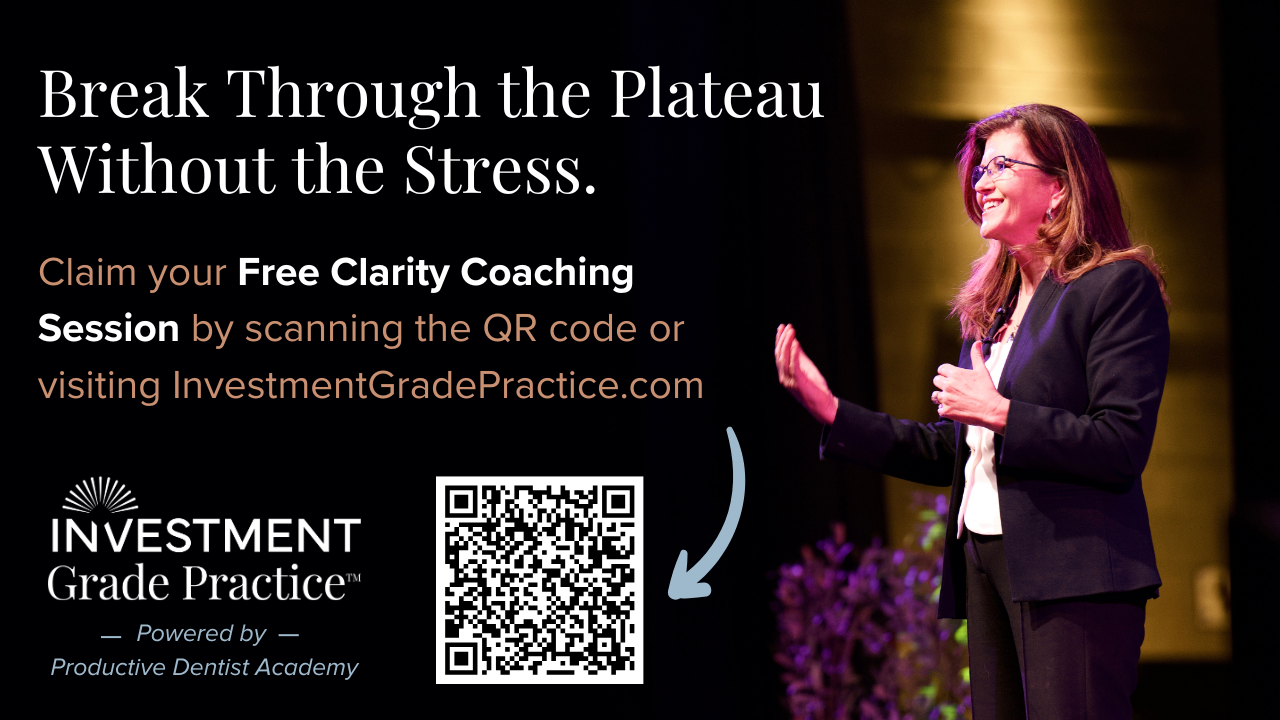
- Do the free assessment meeting.
- Book here: Productive Dentist Academy coaching session on Calendly.
If you want help seeing your practice accurately, book a 30 minute clarity call: Investmentgradepractice.com. (Victoria holds five spots per week).
Do the free assessment meeting.
Book here: https://calendly.com/productivedentistacademy/coaching-session?utm_source=IGP-Website&month=2026-02
TRANSCRIPT
[00:00:00] Intro: The Productive Dentist Academy Podcast Network.
[00:00:04] Victoria Peterson: You are the final decision maker. You are the cultural stabilizer. You are the one people go to when something feels uncertain. And at first this feels normal. It feels responsible, but here’s the uncomfortable truth. Owner reliance is not a badge of honor.
[00:00:22] Victoria Peterson: It’s one of the most expensive liabilities a practice can carry.
[00:00:27] Intro: Welcome to Investment Grade Practices podcast, where we believe private practice dentists deserve to get the lifestyle today while building an asset for tomorrow. Join your host, Victoria Peterson, to design the practice of your dreams and secure your financial independence.
[00:00:43] Intro: Let’s get started.
[00:00:45] Victoria Peterson: Welcome to the productive Dentist AC Academy’s Investment Grade Practice podcast. This episode we’re talking about owner reliance. The most expensive problem for private practice dentistry. There is a [00:01:00] pattern that I’m seeing in almost every solo, like one to three location independent practice groups, and it’s so common that most owners don’t even question it.
[00:01:12] Victoria Peterson: The practice relies heavily on the owner. Period. End of statement. You are the final decision maker. You are the cultural stabilizer. You are the one people go to when something feels uncertain. And at first this feels normal. It feels responsible, but here’s the uncomfortable truth. Owner reliance is not a badge of honor.
[00:01:35] Victoria Peterson: It’s one of the most expensive liabilities a practice can carry Owners. Reliance doesn’t happen because you’re controlling. Like don’t worry about being OCD or a control freak. It happens most often because you care. You over care. You want clinical excellence, you want patients treated well. You want the team aligned.
[00:01:59] Victoria Peterson: So when [00:02:00] something isn’t clear, you step in to fix it. And when a system isn’t strong, you compensate for it. Just move that patient to my schedule. So when leadership isn’t developed. You absorb the gap. Oh, I would love for my office manager to do this, however, I don’t know that she can. That’s a leadership gap.
[00:02:19] Victoria Peterson: Over time, the practice just begins to depend on your presence to function smoothly. Not because you designed it that way, but because no one else was given authority or clarity to hold it. And why does this feel like such a strength? Well, here’s why that becomes dangerous. Owner reliance feels powerful.
[00:02:39] Victoria Peterson: I am at the center of my universe and hear me well. I want you to be at the center of leading your practice, but not necessarily the center of managing it.
[00:02:50] Ad: At Productive Dentist Academy, we’ve helped thousands of private practice owners find the clarity inside their data and take control again, starting with a free 60 minute coaching session.[00:03:00]
[00:03:00] Ad: Head over to investment grade practice.com right now before the next patient sits down to claim your free 60 minute coaching session. That’s investment grade practice.com.
[00:03:10] Victoria Peterson: So owner reliance, you know you’re there a little too much when you say, if I’m here, things run well. If I check it, it gets done right.
[00:03:19] Victoria Peterson: If I handle it, it won’t fall apart. And in the short term, that is so often the case. That is absolutely true, but in the long term, it creates fragility. If no one else knows what’s in your brain and how to make these decisions, then you become the glue and everything weakens the moment you step away. So that’s not strength, that’s centralized dependency.
[00:03:44] Victoria Peterson: It’s not right or wrong. I just wanna be really clear in naming what it is. We’ve created a centralized dependency and in the first five years of practice, that’s great. Somewhere between year six and year 10 when you wanna take more time off and, and have more balanced life with your family. [00:04:00] It becomes a problem when you go to sell and you wanna walk away.
[00:04:05] Victoria Peterson: But. You can’t because you’ve gotta sign a five year contract for goodwill purposes. This is why DSOs and pe uh, private equity require three to five year, uh, relationships post-sale. Because you have become so dependent, it will fall apart. There are doctors leveraging out that have associates that have well-run practices that can step away in six to 12 months.
[00:04:30] Victoria Peterson: It’s all possible. But it’s by design. So let’s think about the hidden cost to you. So owner resilience, it’s, we’ve been taught that this is a badge of honor, but it does cost you an uninterrupted time off. So think back to your last vacation. Were you really on vacation? Did you have true mental space to relax?
[00:04:56] Victoria Peterson: Did creativity come back? Did you have some bandwidth for [00:05:00] that? And. Are is thinking about the practice and putting out the fires, robbing you of your ability to look long term and create some options for yourself. So even when revenue is strong, your nervous system. Never really relaxes. And if you haven’t started hearing about nervous system health or central nervous system health, uh, mind body connections, neuro coaching, neurolinguistic programming, all of these things, um, I’ve been doing this since the mid nineties and I’m seeing now that many other coaches are starting to look at deregulating, downregulating, the nervous system because that’s when you really become your most productive.
[00:05:44] Victoria Peterson: In short terms, it’s how do I de-stress my practice and my life? Because you know, somewhere in the back of your mind, if you don’t do that, you know, like if I’m not paying attention, something could happen. And that’s your nervous system being [00:06:00] on hyper vigilance. It’s background noise. It creates brain fog, it creates this exhaustion.
[00:06:07] Victoria Peterson: Your nervous system becomes exhausted, and we don’t yet even have a name for that in our society. So we let it build up to the point that we go, I give up, I’m burned out, I’m tapping out. I’m trapped in the operatory. I must go. But I’m just here to let you know that you can love your practice. You don’t have to sell tomorrow, but you do have to have a plan for one to three years, five years down the line, so that you give yourself a runway to build it in a way that it becomes less dependent on you as it becomes more valuable to your future buyer.
[00:06:45] Victoria Peterson: And this isn’t a personal failure, this is an architectural design misalignment. So beyond the emotional pieces of it, it really is structural. So from a valuation perspective, if I’m putting [00:07:00] on my investment grade practice hat, practices that rely heavily on the owner carry more risk, and buyers and partners look for systems that are transferable.
[00:07:13] Victoria Peterson: So are your systems documented when you onboard new people? Can they be onboarded easily? If so, you could get another half turn on your multiple. Is leadership distributed? Have you spent the time growing the people? In your organization, not just growing the patient base. That’s huge for a buyer, especially a solo buyer.
[00:07:36] Victoria Peterson: So if you’re going the associate to partnership route, or a new dentist moving to town, and you becoming the associate distributed leadership that follows the system, ooh, this is so key. It follows the system and the. The values, not necessarily the person. Do you see how you may have made your practice so tightly dependent on [00:08:00] you and your personality, that it makes it tough to transfer to the new owner and that will decrease your value?
[00:08:09] Victoria Peterson: See consistent standards, independent of your personality. That’s what increases the multiple. So even if production is strong, when a buyer’s, the buyers are savvy these days and they’re looking for those types of, of. Design flaws, if you will, of this is so dependent on the personality of this superstar dentist who does it all.
[00:08:36] Victoria Peterson: It will be very difficult to replace them with an ordinary human. So I, I know some of you, you’re amazing. Wonderful people, and it’s gonna take you a little bit longer to bring the associates up to speed with your service mix to bring your team up to speed with complex diagnostics, and it is all so very possible.
[00:08:58] Victoria Peterson: So let’s build systems [00:09:00] that are transferable. Right. Let’s not limit your scalability. Let’s not limit your equity growth. Let’s not limit your exit optionalities by holding this badge of honor that I have to do everything. This is the episode where you, you know, you. A couple of episodes ago, you learned you’re not broken.
[00:09:20] Victoria Peterson: Last episode you learned that you can stand right where you are. There’s nothing to fix, but get still enough to see where your opportunities are. And now I’m telling you, once you stand in that stillness for just a bit, now you know how to delegate. Because delegation alone does it fix things, right? So if you’re hearing this conversation and you think the takeaway is, I just need to delegate better, I want you to know that delegation without that clarity is gonna create chaos.
[00:09:51] Victoria Peterson: So please take the moment. Take me up on my offer to have a clarity call. You’ll be amazed at what you discover about yourself in 30 minutes or less [00:10:00] because without clarity, you can’t delegate. ’cause you can’t delegate ambiguity. Trust me, I’ve tried. I’m very big picture. My team goes, can you, can you gimme some details on that?
[00:10:11] Victoria Peterson: So if the standards are in your head. If authority boundaries are fuzzy. If reporting lacks a bit of discipline, sometimes we have staff meetings, sometimes we don’t. Sometimes we talk about numbers. Most of the time we don’t. Then delegating is only gonna spread the confusion like wildfire. So the solution isn’t less involvement from you, it’s clearer structure.
[00:10:36] Victoria Peterson: Once you get the clear structure, uh, as Bruce would always say, inspect what you expect. So I’m sharing with you, let’s clarify the expectations first. Then you can start stepping back to inspect it. So what does it look like to reduce owner reliance? It requires three things, explicit [00:11:00] standards. I’ve said this before.
[00:11:01] Victoria Peterson: What does that mean? It means it’s written. It’s visible, like it’s written in plain language on one page, it’s visible. If it’s important, it is laminated and it’s in the operatory. So if it’s a daily SOP for patient care, it’s one page. It’s written, it’s visible, it’s la, and it’s measurable. So explicit standards for each role, explicit metrics for.
[00:11:27] Victoria Peterson: Production collections, et cetera. You also need to define the authority. Who gets to decide what without escalating it up to you. So now you’re putting in some gates. So we’re gonna have, um, the ability to create a de a design. Uh, an authority matrix. We have this here at PDA. We’re a very complex company.
[00:11:49] Victoria Peterson: We have a, a full service ad agency. We have investment grade practice coaching. We have business advisory. We have clinical calibration and clinical mentorship. We [00:12:00] do live events, we do masterminds. We do a lot of things here. Without decision authority, I would probably work 20 hours a day. Just making decisions.
[00:12:09] Victoria Peterson: I have such an amazing, capable team around me, but we had to go through this process of writing it out and deciding who gets decide what, and then comes the development piece. Just because you give somebody a title does not mean they know how to do the job. So loyalty does not mean that they get.
[00:12:28] Victoria Peterson: Promoted to manager, although that’s often how it happens. You’re the last person standing in the department that makes you the longest one here. So now you’re the lead. But leadership development is a process in itself. Um, so without it. You can’t really delegate to a manager or decision maker unless you’re willing to invest in their development and finding some coursework for them.
[00:12:54] Victoria Peterson: So when these, the things exist, the explicit standards, the defined authority [00:13:00] and leadership development. Actually pouring resources into your team, then the practice will not collapse when you step back. So if you were to go back to a previous podcast, we used the metaphor of you being the the load-bearing wall.
[00:13:16] Victoria Peterson: Now you’re framing out other exterior walls so that it doesn’t collapse. You know, we can put in a header beam here. You don’t have to be the Lober Mall. Everything stabilizes. And when that happens, something really powerful,
[00:13:31] Ad: really powerful
[00:13:32] Victoria Peterson: happens. You stop being the glue. So you’ve got your job as a chairside clinician being an operator.
[00:13:41] Victoria Peterson: You’ve been the glue, the emotional glue, the cultural glue, the decision-making glue that holds it together. You can stop being that because you’re gonna start being the architect. That’s why it’s so important to stabilize where you are. Teach your team the systems as they are and [00:14:00] optimize where they are.
[00:14:01] Victoria Peterson: Then you delegate, then you free up your time. Now you get above the noise. Which is where freedom lives, and you can begin to design and architect out the next one to five years. And I can tell you that part is so much fun and you’re gonna have an identity shift. You move from the indispensable operator to the intentional designer.
[00:14:24] Victoria Peterson: What is that like? You move from a reactive problem solver to a leader, a directional leader, removing in this direction and that shift, like I’ve said before, it can feel uncomfortable at first. Like, oh, are they really gonna follow? But the difference between owning a job and owning an asset is you becoming this architect.
[00:14:48] Victoria Peterson: Let’s help you build that investment grade asset. Otherwise, you’re gonna spend 30 years in a highly paid job, so a independent dentist. I think you deserve to [00:15:00] have more assets. We all deserve to have more asset builders and fewer exhausted owners. Hey, if this episode resonates with you, I gotta tell you, it is something deeply personal to my heart.
[00:15:14] Victoria Peterson: I love helping doctors who are in mid to late career turn things around. You’ve worked so hard, you’ve given so much, but being needed for everything. I have to tell you, it’s not a strength. It’s a sign that your structure hasn’t really caught up with your vision. I can help you build that structure around your vision.
[00:15:33] Victoria Peterson: So if you do want help with that. Um, as always, I am offering a 30 minute no obligation clarity call, and I do continue to hold five spots per week open for these, uh, if you’re an independent practice owner with one to three locations, that’s who I love working with. Remember, clarity restores your energy and remaining inside that confused owner dependent structure.
[00:15:56] Victoria Peterson: It’s going to continue draining you. When you’re ready to [00:16:00] stop the energy drain, hey, click the Calendly link below. I can’t wait to chat with you.
[00:16:06] Intro: Thank you for tuning into this episode of Investment Grade Practices Podcast. If you find value in this episode, help us spread the word by passing it along to a dental friend.
[00:16:15] Intro: Subscribe and give us a like on iTunes or Spotify. Learn more about building your investment grade practice@productivedentists.com today.
Have a great experience with PDA recently?
Download PDA Doctor Case Studies



Drs. Clint & Kelly Euse
PDA Members Since 2008
Advanced Dentistry by Design
Carson City, NV